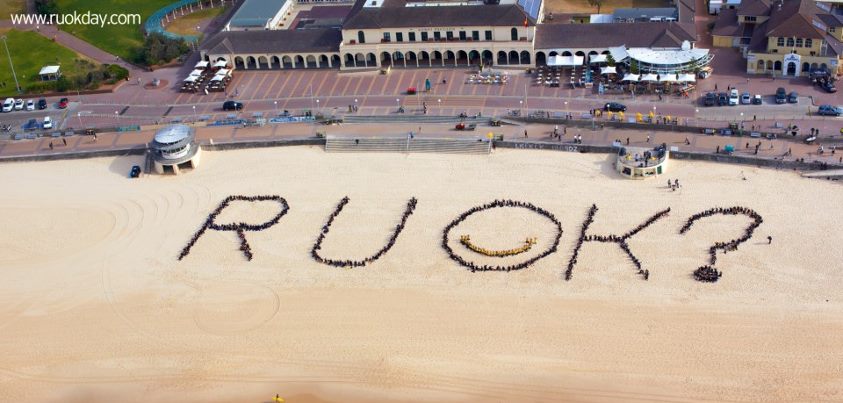
RUOK Day. Gratitude Experiment: Day 34


Photo from http://www.RUOKday.com

One of my lovely followers who lives in Australia liked the post I made about depression the other day after my friend lost her son (the funeral was today). This blogger mentioned Australia’s national  RUOK Day. I was intrigued and had to look it up.

According to the RUOKday.com website, R U OK? Day is a national day of action dedicated to inspiring all Australians to ask family, friends and colleagues, ‘Are you ok?’  The day encourages reaching out to one another and having open and honest conversations in order to become a more connected community.  And in the end, to help reduce the country’s suicide rate.

The day is celebrated on the second Thursday of September (last Thursday).  The site explains that in the time it takes to have your coffee, you can start a conversation that could change a life.

RUOK? is a not for profit organization that works wiith various Information Partners to provide national focus and leadership on suicide prevention by empowering Australians to have open and honest conversations and stay connected with people in their lives.

R U OK? Day was inspired by the son of Barry Larkin (1940 – 1995).  The day is dedicated to his father and all people who have died through suicide, as well as the family and friends who love them. The first RUOK? Day was in 2009 and after only three years an estimated 58% of the Australian population knew about the national day of action. By last week, which marked the fourth year, I’m sure the number had increased.

The website provides resources for connecting with people in the workplace, schools, health facilities, universities and community and sports clubs.

The Aussies are onto something.  I’m not aware of a single, unified suicide preventive effort like this here in the U.S., and I think we could use one.  And frankly, the more we rely on technology to communicate, the more disconnected we become. And the more we need a day like this to promote awareness for the importance of staying connected.

We should all think about asking R U OK? more often.  We never know when we could impact a life with a just few more moments of connection, listening and empathy. 

Today I am grateful for the many inspirations that come from my fellow bloggers, like this heartwarming and sensible concept.

For more information about the organization, as well as steps for how to reach out and start these conversations, visit http://ruokday.com.

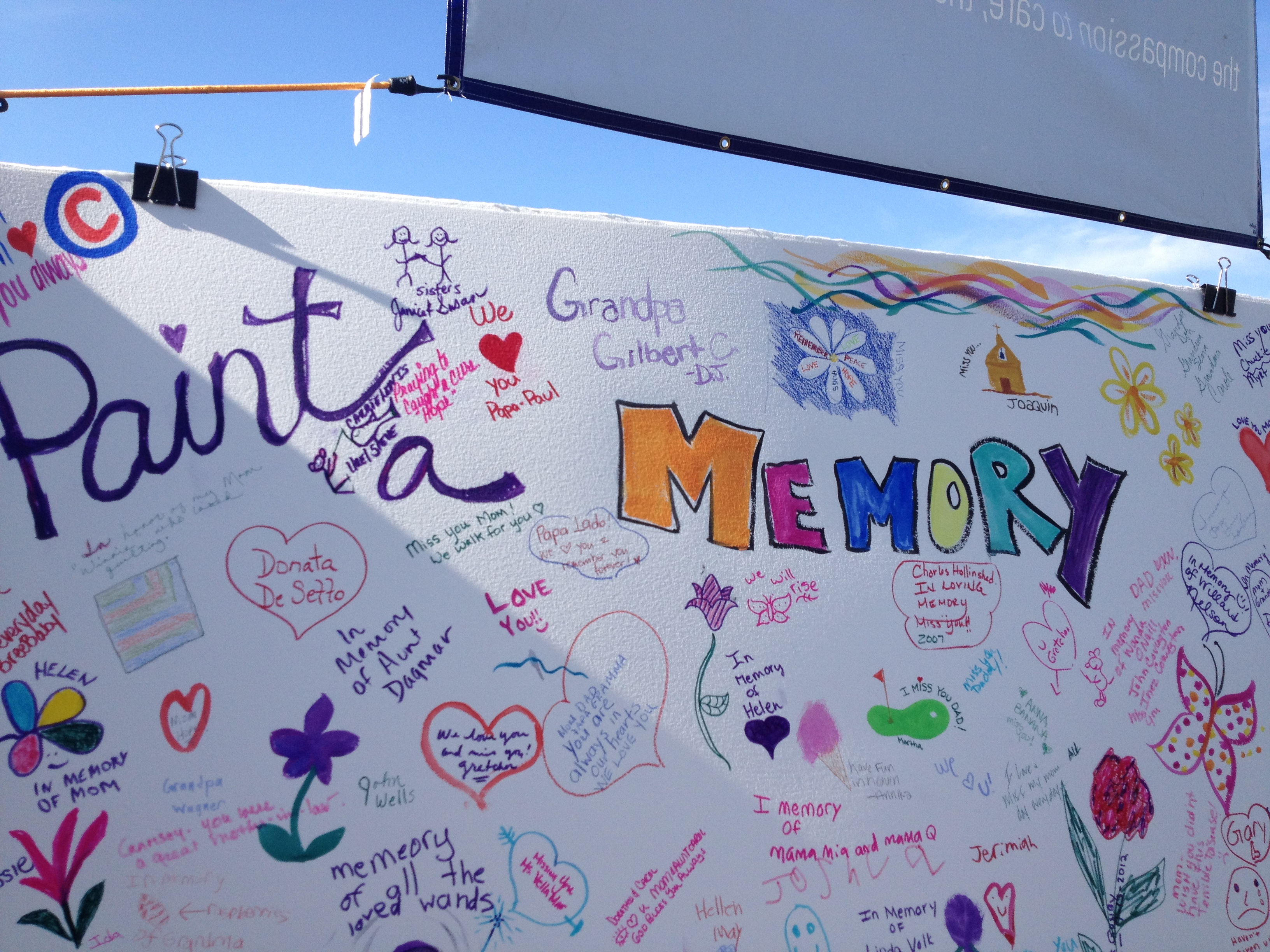
 

I’m Seeing Purple. Gratitude Experiment: Day 32

I walked in the Walk to End Alzheimer’s this morning. What a terrific feeling of hope and camaraderie to walk away with. Last year the Denver walk broke its record with 8,000 walkers.  I guarantee you it was an even bigger crowd today.

I walked with a good friend who walked in memory of her mother who she lost to Alzheimer’s three years ago.  And I walked in memory of my Aunt, who we lost to Alzheimer’s a year ago this month and in honor of her sister, my Mom, who I’m losing to Alzheimer’s a little more each day.  I drew a picture of them on a huge sign they had for people to paint memories of their loved ones.

In a sea of purple, I saw photos on the back of so many walkers’ shirts. Photos of loved ones lost to this hateful disease. The thought that so many like me are fighting this fight is both comforting and terrifying.

This disease isn’t going away anytime soon, as the numbers continue to climb.  Yet it seems like the world is in denial about this disease and how very real it is.  Perhaps it doesn’t seem as real because you don’t visit anyone in the hospital when they have this disease?  And because you never hear anyone with it describing their suffering?  Because they can’t speak for themselves.

But it is very real.  And someone new is diagnosed every 68 seconds.  And by 2050 it will be someone new every 33 seconds.

Ironically, federal funding for Alzheimer’s research pales in comparison to that for other chronic diseases. According to University of Mississippi Medical Center, the $450 million allocated by the National Institutes of Health (NIH) is equivalent to less than 15% of the research funding for HIV/AIDS, less than 11% of funding for cardiovascular disease research, and less than 8% of funding for cancer research.  And for every $28,000 spent on Alzheimer’s patient care, only $100 is spent on research.  In fact, the government funds more nutrition research than it does Alzheimer’s research.

I recently had the privilege of listening to a scientist discuss research initiatives and progress made. Scientists believe we are getting close and even at a tipping point.  We just need a commitment from the federal government to fund research.

And we’re getting there. In January of  2011, the National Alzheimer’s Project Act (NAPA) was signed into law by President Obama. According to the Alzheimer’s Association, The National Alzheimer’s Project Act (NAPA) will create a coordinated national plan to overcome the Alzheimer’s crisis and will ensure the coordination and evaluation of all national efforts in Alzheimer’s research, clinical care, institutional, and home- and community-based programs and their outcomes.

But it’s going to take much more. The public has to make it known what our federal priorities with regard to the impending Alzheimer’s epidemic should be, especially given shrinking budgets at every turn.  More people need to speak up and take action, contact their Congress representative or become advocates through the Alzheimer’s Association.  To put faces on the need. The website of the Alzheimer’s Association has advocacy pages dedicated to helping you do just that. http://www.kintera.org/siteapps/advocacy/ActionItem.aspx?c=mmKXLbP8E&b=7516993&auid=8520366  I know this is  a blatant plug for my cause, but I know with every molecule in my body that you DO NOT want to watch this happen to anyone you love.

If you’re still reading this and you’re not exhausted, I commend you.  And I appreciate you taking the time.  I’m truly grateful that you are reading this, that I went on that walk today, and that we can end this.  Let’s do it.

Why Alzheimer’s Is a Drag. Gratitude Experiment: Day 31

Even though it goes against the grain of my 100-day Gratitude Experiment, I feel the need today to write about why my Mom having Alzheimer’s is a drag.

I’m convinced that some gratitude will come to me by the time I finish writing this.  And I’m hoping these thoughts will help my readers cherish every moment they have with their loved ones.  And take nothing for granted.

My Mom having Alzheimer’s is a big fat drag because:

1. I wish I would have spent more quality time with her before she got sick.

2. I wish I had asked her if her favorite color was still yellow when she could still tell me.

3. I wish I would have paid better attention to the signs in the beginning.

4. I desperately wish for rare moments of clarity to happen when I am near.

5. I worry about her dignity.

6. Most healthcare workers have no clue how to treat a person with Alzheimer’s.  And it makes me want to help change happen.

7. She is afraid to take a bath.

8. I wish I could remember the name of that flowery lotion my grandmother used to give her every Christmas.  And I wish I had someone to ask that would know.

9. I worry about my Stepdad being sad and tired.

10. I worry about my Stepdad getting hurt and me not knowing.

11. I wonder how much of what I say she understands.

12. I wonder if I offend her by babying her.

13. I  wish I had taken better notes about my family history.

14. I wish I really knew when all this started – so hard to tell.

15. I worry about when the next shoe is going to drop.

16. I think about how she would not want to be this way.

17. I worry that she is frightened and she can’t express it.

18.  I’m scared to death it’s going to happen to me.

On the other hand, I am still able to be grateful because:  (whew, glad some gratitude came through)

1. I love it when I have what seems like a tiny a breakthrough with her.

2. I am happy when she smiles her old smile.

3.I love to be silly and make her laugh (when I use Three Stooges type humor it cracks her up).

4. I can tell she enjoys changing the bed sheets with me.  Especially if I’m silly while we’re doing it.

5. She’s still my Mom in there.

6.  I love that she said  really sweet things to me that day a year ago when I did her hair for her, when she was better able to comprehend and talk.

7. My stepdad is solid as a rock, and I love him for it.

8. I’m lucky that she lives close now so I don’t worry even more.

9. I can have these tiny moments of joy with her to always remember.

Thanks for reading.

My Kimono Won’t Close. Gratitude Experiment: Day 28


My husband uses the term ‘open kimono’ to describe my transparent ways.  It’s because I’m not physically able to tell you one thing and really mean another, even if I tried really hard.  And why I would really suck as a salesperson selling anything that I didn’t believe in.

It explains why women who host home trunk show clothing parties, jewelry open houses, or cooking gear parties can’t stand it when I’m one of the guests.  Because everyone there knows that I’ll tell you if you look 30 pounds heavier in the latest trendy vest or if you look like you’re drowning in the latest fashion-forward floor-length dress.  Usually ten minutes in, guests realize that I’m someone who will give them an honest opinion despite its potential impact to a bottom line.

Urbandictionary.com defines the ‘open kimono’ phrase as: (adj.) – business marketing plan that allows consumers to know what’s behind the entire operation, with no secrets kept inside the proverbial kimono.

Some say the phrase dates back to feudal period of Japanese history, when warriors or adversaries would open their kimonos as an offering of trust to show they had no hidden weapons.

My open kimono explains why those who are friends with me know right where they stand with me at any given moment.  I don’t attempt to hide joy, worry, appreciation or aggravation. (I’m actually not sure if I would be physically able to.) I’ll tell you if you’ve hurt my feelings or upset me and I will be completely honest about it.  I’ll also make sure you know if you’ve touched my heart.

I cry at school plays, I cry at weddings, and I cry when I sing Amazing Grace because it reminds me of my grandmother who cried when she sang that song.  I still cry when I say goodbye to my parents after a trip back home. And sometimes I cry when I tell a happy story that makes my heart swell.  And I’m okay with all of it. Even though tears make stoic types uneasy, I know that letting my guard down allows me to tap into depths of emotion that left untapped could make me stale.

Sometimes I think about closing my kimono a little more often.  But then I remember what a fleeting gift this life of mine is.  So why waste time not getting to what’s real when it could all change tomorrow.

I realize this is who I am, open kimono and all.  And for that I am grateful.

When I grow up. Gratitude Experiment: Day 26

I want to be like my neighbor when I grow up. He lives across the street from me. He and his wife raised all of their children in that house.  Their kids now live in various states, with children of their own.  I think he is very close to 90 years old.

He yells ‘Hi neighbor!’ to me from across the street every time he sees me. He calls me by the wrong name sometimes but that just makes me smile all the more. I have never seen him unhappy.

I have to speak  loudly when we chat because he is very hard of hearing and has Meniere’s diseasean inner ear disorder that affects balance and hearing. Many afternoons you can see him jogging or riding his bike around our neighborhood. He tells me that he thinks if he just keeps active maybe he can jiggle things around enough up there in his head enough that it will work itself out.  He also just quit skiing black runs about four years ago. For real. (I’m doing good to ski blue runs.)

When we have big snows, he uses his snow blower to remove snow from our entire cul-de-sac’s sidewalks. And sometimes he does all of our driveways too (we live in a small cul-de-sac thank goodness).

He has a killer old red sports car that he drives every clear day.  I can hear its engine rumble as he zooms off each morning with his hat on that reminds me of the one Gilligan wore on Gilligan’s island.

On trash pickup days if I’m gone after the truck as come, he returns my trashcan to the back of my driveway for me.  And he does this for all of us. He also brings us all a jar of home-made jelly from his church sale during the holidays.

He has a compliment for me every single time I talk with him.  And he calls me when he needs to know how to do something on his computer, always ever so thankful for my help.

Today I am grateful that I get to live by this great guy who provides me with a wonderful example of how to live life. I hope I can be like him when I grow up.